On the evening of November 14, 2025, heavy rain sent a slope on Queen Anne Hill sliding. Seattle Fire crews responded to a building at 423 W. Republican Street and found that the ground behind the structure and beneath a section of sidewalk had washed out from underneath. The Seattle Department of Construction and Inspections yellow tagged the building the same night, meaning it could still be occupied but with restrictions, and closed the walkway until temporary stabilization went in.
Nobody talks about that address anymore. But if you're getting ready to sell a Queen Anne home cut into a slope, that night is still doing quiet work in the background of your transaction. It's exactly the kind of event that trains a buyer's inspector, or a buyer's attorney, to ask a specific question about your retaining wall that has nothing to do with whether the wall looks solid.
The question isn't "is the wall standing up straight." The question is "is the wall permitted." Those are two separate tests, and on Queen Anne's glacial till hillsides a wall can pass the first one cleanly and fail the second one quietly, which is exactly where sellers get blindsided mid-escrow.
A Wall Can Look Fine and Still Be a Disclosure Problem
Seattle's rule for when a retaining wall needs a construction permit is narrower than most homeowners assume. According to the Seattle Department of Construction and Inspections, you only avoid a permit if all three of these are true at once.
| Condition | What it means |
|---|---|
| Height | The wall is 4 feet or lower, measured from the bottom of the footing (even the buried part) to the top |
| Location | The parcel is not in a mapped Environmentally Critical Area |
| Property impact | Construction won't damage an adjoining property or structure |
Miss any one of those three and you needed a permit, whether the wall was ever pulled or not. Queen Anne, along with Capitol Hill and Beacon Hill, sits on glacial hills where driveway and yard walls were routinely cut straight into hardpan till, often decades before anyone was thinking about environmentally critical area review. A wall built at or near a property line trips the exemption too, since a wall that close to a neighbor's land carries the potential for damage regardless of how well it was built. That's a common footprint on Queen Anne's narrow, closely built lots.
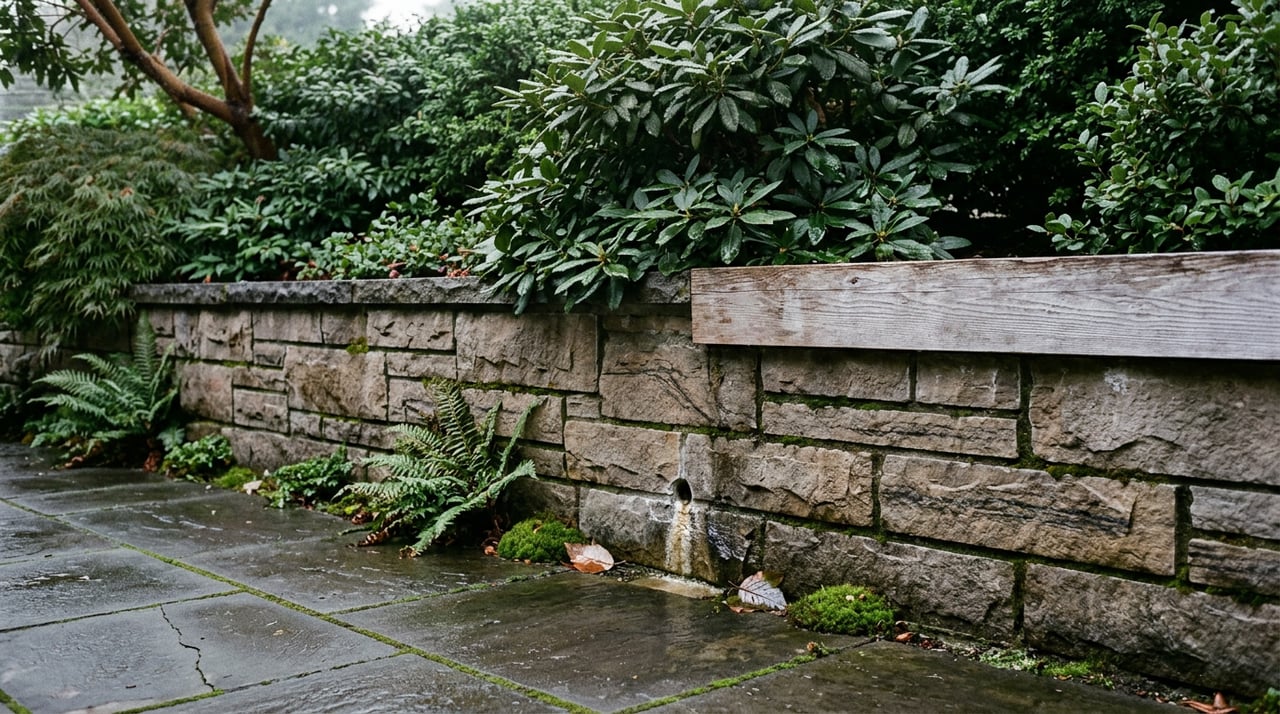
None of this shows up by looking at the wall. A rockery can be bone dry, plumb, and thirty years old, and still have no permit on file if it sits on a steep slope parcel or crowds a lot line. The wall's condition and the wall's paperwork are answering two different questions, and a seller who only checks the first one is leaving the second one for the buyer's side to discover.
Why the November Landslide Is the More Useful Data Point Than the Wall Itself
Most Seattle retaining walls don't fail because the wall itself was weak. They fail because water built up behind them with nowhere to go. On Queen Anne's soil profile, rain works down through loose surface soil until it hits the dense glacial till underneath, then it perches there and pushes sideways against whatever is holding the slope back. That mechanism runs hardest from November through March, which is exactly when the Republican Street slide happened.
That timing matters for how you think about your own wall. A dry summer inspection tells a buyer very little about how a wall performs in February. A permit file, by contrast, tells them whether the wall was ever engineered for drainage in the first place, since walls that require a permit typically require a stamped design that accounts for backfill, weep holes, and an outlet that actually daylights. The permit isn't a formality. It's the only record that the water problem was addressed on purpose rather than by luck.
What Form 17 Actually Asks You to Know
Washington's Real Property Transfer Disclosure Statement, universally called Form 17, has been required on residential sales since 1995 under state law. Its structural section covers the foundation, settling, walls, additions, and any unpermitted work you know about, and for Seattle homes built before 1990 this is the section buyers and their inspectors read most carefully.
Queen Anne's housing stock makes that section relevant on nearly every listing. Upper Queen Anne is dominated by Craftsman bungalows, Tudor Revivals, and the namesake Queen Anne Victorians, most built between the 1910s and the 1940s. A house that old has usually had at least one prior owner do yard work, add a patio, or cut in a wall long before anyone thought to check an environmentally critical area map. If you don't know whether that work was permitted, "don't know" is a legitimate answer under Washington's actual knowledge standard. What creates risk is guessing "no issues" when you never actually checked.
The legal mechanics matter too. Once you deliver Form 17, the buyer has three business days to rescind the agreement. If you learn the form was inaccurate before closing, you're required to correct and redeliver it unless you make the necessary repairs first or the information came from the buyer's own inspector. That's not a hurdle to dread. It's a reason to find out what you're disclosing before a buyer's inspector finds it for you.
The Real Shift Isn't the Wall. It's the Clock.
Here's the part that catches experienced sellers off guard. In the three months ending June 2026, Queen Anne homes sold at a median of roughly $1.0 million, and the typical listing took about 21 days to go under contract, up from roughly 8 days a year earlier.
That gap changes what a retaining wall means for your sale. During the frenzy years, buyers who wanted a Queen Anne view lot often waived inspection contingencies to compete, and a wall's permit status simply never came up before the deal closed. A listing sitting for three weeks instead of one gives buyers something they didn't have as much of before: time. Time to order a geotech opinion. Time to run a permit history search through the city. Time to notice that a wall holding up a side yard has no paper trail and use that during their contingency period to renegotiate price or walk.
The wall itself hasn't changed. What's changed is how much runway a buyer now has to actually check it, and that runway is longer than it's been in years.
What to Do Before You List
A little groundwork now is cheaper than a renegotiation later.
- Pull your property's permit history from the city before you list, not after an offer comes in. If a wall over 4 feet has no record, you have options while you still control the timeline.
- Check whether your parcel falls inside a mapped Environmentally Critical Area. If it does, the 4-foot exemption doesn't apply regardless of the wall's actual height.
- If the wall sits at or near a property line, get clarity now on who built it and who has claimed responsibility for it. That question is much easier to answer before a buyer's attorney raises it during closing.
- If you know of a permit gap, decide deliberately whether to pursue a retroactive permit, commission an engineer's letter documenting current condition, or disclose plainly in the comments section of Form 17. All three are legitimate. Silence is not.
- Use the comments box on Form 17 the way it's meant to be used. A short, factual note about a wall's age, any past repairs, or an unresolved permit question reads as straightforward, not alarming.
A Few Direct Questions
Does every retaining wall on a Queen Anne lot need a permit? No. A wall under 4 feet, outside a mapped critical area, and not risking damage to a neighboring property can be built without one. Once any of those three conditions isn't met, a permit is required regardless of the wall's age or appearance.
What if I genuinely don't know whether a past owner pulled a permit? Then "don't know" is the correct answer on Form 17. The standard is your actual knowledge, not a guarantee. A single unknown on an old feature is normal. A pattern of "don't know" across structural, water, and permit questions on a home you've lived in for years is the kind of thing an inspector or buyer's agent will want explained.
Can a buyer walk away over an unpermitted wall found during inspection? Buyers can use findings from an inspection to renegotiate price, request repairs, or in some cases exit the contract during their contingency period, depending on how the purchase agreement is written. That's exactly why finding the permit gap before you list, rather than after an inspector does, keeps you in control of the outcome.
Selling a home on Queen Anne's slopes means selling the site as much as the structure. A retaining wall with a clean permit history is one less thing for a buyer's inspector to flag and one more reason your listing moves through escrow without a detour. If you're weighing whether now is the right time to list a Queen Anne property, The Shutes Team can walk your specific lot, pull the permit history, and help you get ahead of exactly this kind of question before a buyer's inspector asks it first.