In 1906, the Laurelhurst plat set aside a quarter-acre finger of land called Waterway 1, a grassy strip meant to give the whole platted community a shared path down to Lake Washington. For most of the twentieth century it worked as intended. Then, over the following decades, the homeowners on either side quietly folded it into their own yards. Fences went up. A hedge grew to more than 2,400 square feet. A dock appeared on the tidelands. By the time the Washington Department of Natural Resources got involved, one owner was writing an annual check to the city just to keep the hedge in place, and the family on the other side, which included Bill Gates's sister, was negotiating a $10,000 settlement with the state for the dock built on land that was never theirs to build on.
Nobody woke up one morning and decided to steal public shoreline. The dock got built, the fence got extended, the years passed, and it simply became normal. That is the part sellers on Lake Washington need to sit with. In Laurelhurst, "it's been there for decades" and "it's permitted" are two entirely different claims, and the gap between them tends to surface at the worst possible moment: during disclosure review, a week before closing, not during the walkthrough.
The dock you're selling was built under different rules than the dock you'd build today
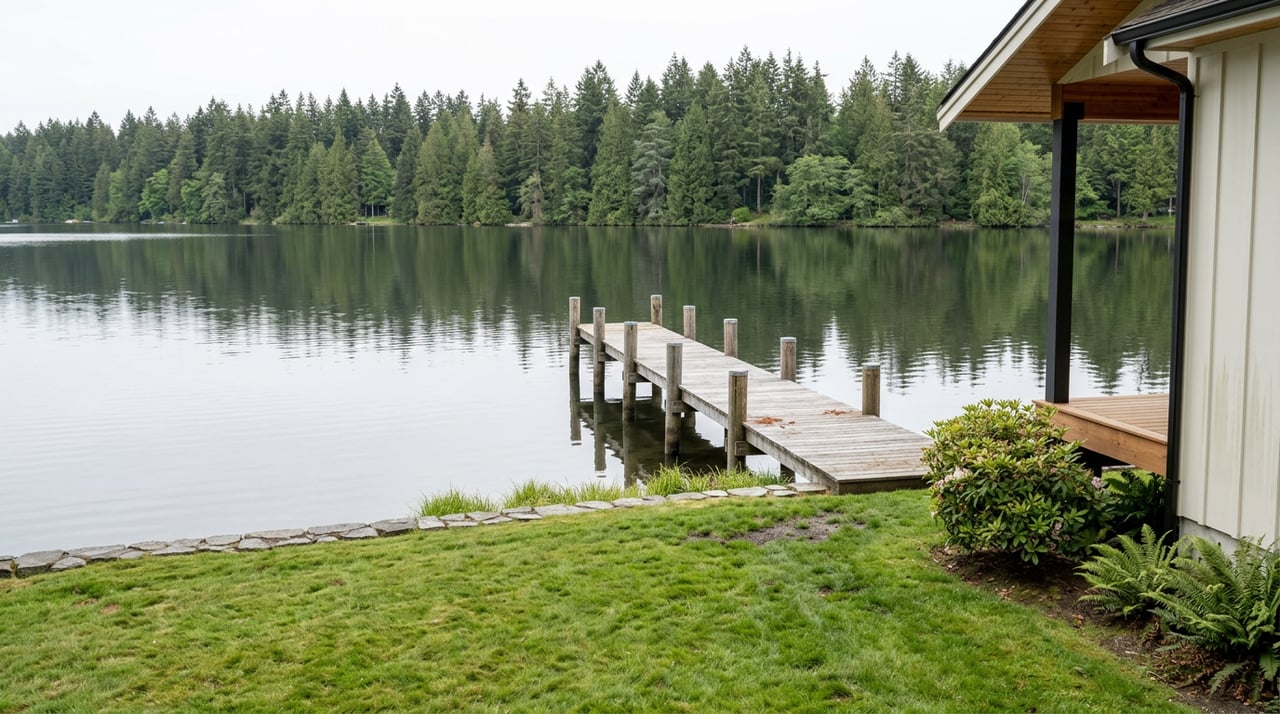
Seattle's Shoreline Master Program regulates every property within 200 feet of Lake Washington, which covers the overwhelming majority of Laurelhurst's waterfront lots. Anything that counts as a substantial development inside that district needs a shoreline permit, and the dollar threshold for what counts as substantial is lower than most sellers assume: $8,504 for general shoreline work. Docks get their own carve-out. Replacing an existing dock with one of equal or smaller footprint has a higher threshold, $28,000, but only if the work meets that specific test and only in jurisdictions that have updated their shoreline master program to match state guidelines.
Here is the part that catches people off guard. That $28,000 threshold applies to a straightforward swap, same size or smaller, no upgrades. The moment a seller's dock has grown a boat lift, extra decking, or a covered slip somewhere along the way, it may no longer qualify as the kind of replacement the exemption was written for. A structure can look identical to what stood there thirty years ago and still fail that test, because what actually changed is not always visible from the yard.
City permitting is also only one layer. Any work below the ordinary high water mark, which includes most piling and dock work, needs a Hydraulic Project Approval from the Washington Department of Fish and Wildlife. Anything involving fill below the water line typically needs a Joint Aquatic Resource Permit Application reviewed by the Army Corps of Engineers. A dock can clear the city's threshold and still be missing sign-off from one of these other agencies, and a title company reviewing the file has no way to know that from looking at the structure itself.
Why "everyone on this street has a dock like this" isn't proof of anything
This is where Waterway 1 is useful as more than a cautionary story. The families who built there weren't acting outside the neighborhood's norms. They were doing what their neighbors had already done, on a public easement that had simply been forgotten by the agencies responsible for tracking it. It took a 1995 newspaper story to remind Seattle's parks department that it owned a small park on that same stretch, acquired back in 1958 and never developed, before the city reclaimed it.
Waterfront permitting works the same way in miniature on nearly every dock in the neighborhood. A structure that has been standing for twenty years and never caused a problem is not the same as a structure with a complete permit file. Nobody checks until somebody has to, and in a real estate transaction, that somebody is usually the buyer's lender, the title company, or the buyer's own inspector asking a question the seller has never had to answer before.
For a buyer, that means don't take a functioning dock at face value just because it looks original to the house. For a seller, it means the work of confirming what you actually have is worth doing before a buyer's team does it for you, on their timeline, with their leverage.
What to actually check before you list
A seller with a dock, bulkhead, or boat lift on a Laurelhurst property has a short list of things worth confirming early, ideally before the sign goes in the yard rather than after an inspection turns something up.
- Whether the structure has a recorded shoreline substantial development permit or a documented exemption on file with the city, not just a building permit for something else on the property
- Whether any work below the water line has a Hydraulic Project Approval from Washington Fish and Wildlife
- Whether the dock's current footprint, including any lift or covered moorage added over the years, still matches whatever was originally approved
- Whether moorage rights are actually recorded for the property, rather than assumed because the neighbors on both sides have working docks
That last point matters more than it sounds like it should. A dock existing on a shared waterway or a platted access strip does not automatically mean the adjacent homeowner owns the right to use it. Recorded moorage rights and informal, decades-old arrangements are not the same thing, and a title search will draw that distinction whether or not anyone asked it to.
None of this requires assuming the worst about a property. Most docks on Lake Washington were built and maintained properly, and a clean permit history is common, not rare. The point is that a seller who confirms it ahead of time controls the story. A seller who doesn't is handing that discovery to whoever finds it first during someone else's due diligence, at a point in the transaction with far less room to negotiate.
The cost of finding out late
A permit gap discovered during escrow rarely kills a Laurelhurst deal outright, waterfront inventory on this stretch of Lake Washington is too limited and too sought after for that. What it does is change who's paying for the fix and how much time the transaction has to absorb it. An undocumented dock repair can mean a price adjustment, a holdback at closing, or a delay while the seller applies for the exemption or permit that should have existed already. None of those outcomes are catastrophic, but all of them are avoidable, and all of them are more expensive to solve in the middle of a transaction than they are to solve two months before listing.
If you're weighing whether your own dock or bulkhead needs a second look, the city's shoreline permitting page lays out which types of work are exempt and which require a full review, and it's worth an hour of reading before you assume your situation is the simple case.
A few direct questions
My dock has been there since before I bought the house. Am I responsible for its permit history? As the seller, you're responsible for disclosing what you know, and title issues tied to unpermitted shoreline work can surface regardless of who built the structure. It's worth checking the record rather than assuming a prior owner handled it.
Does a small repair, like replacing a few boards, trigger this whole process? Routine maintenance and repair of an existing structure is generally treated differently than new construction or expansion under the city's shoreline rules, but it's worth confirming your specific project qualifies rather than guessing.
What if I just want to sell as-is and let the buyer deal with it? You can, and plenty of waterfront sales close that way. But an unresolved permit question tends to show up in a lower offer, a longer negotiation, or a buyer who walks. Knowing the answer ahead of time gives you more control over how it's handled.
If you own waterfront property in Laurelhurst and want a clear-eyed read on what your dock's history means for a future sale, or you're evaluating a purchase and want someone who has spent years working this exact shoreline, the Shutes Team can walk through it with you before you list, not after a buyer's inspector finds it first. Get your instant home valuation and we'll start there.